
Guide To The Intermittent Bonded Ribbon Production Line
An intermittent bonded ribbon production line connects fiber subunits at set intervals. This maintains fibers in an organized arrangement for mass-fusion splicing while letting the ribbon roll or fold into a compact cable shape. Flexible ribbon cable production is supported by this design while preserving efficient fiber handling.
Some processes apply bonding material before the subunit coating cures. The materials can intermix across their interface and cure together. Prysmian’s FlexRibbon technology provides one commercial example, and the company dates its original design to 2018. Together, these methods demonstrate the relationship between optical fiber ribbon manufacturing and fiber optic bonding.
Fiber Draw Tower
Fiber Coloring Machine
Fiber Secondary Coating Line
Understanding What An Intermittent Bonded Fiber Ribbon Is
An intermittent bonded fiber ribbon groups optical fibers into small subunits. The subunits stay organized for splicing while remaining able to change shape to fit inside a cable.
The Arrangement Of Fiber Subunits And Intermittent Bonds
Each adjacent pair or group of fibers is held together by a coating. These optical fiber subunits connect to neighboring subunits at spaced bond points rather than along their full length. Six two-fiber subunits may form a 12-fiber design. The configurations range from 4 to 36 fibers, and bond spacing ranges from 10 to 1,000 millimeters.
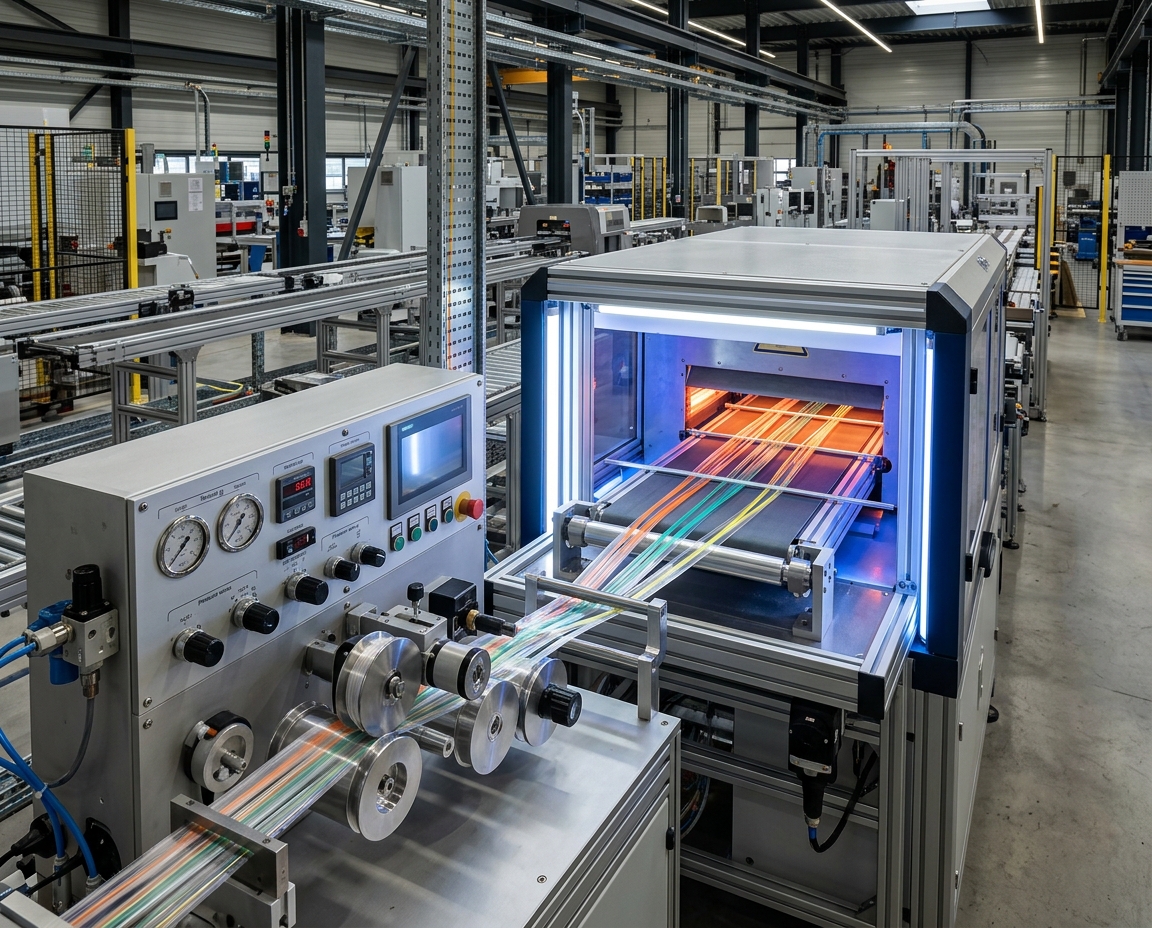 Intermittent Bonded Ribbon Production Line
How Rollable Ribbons Differ From Conventional Flat Ribbons
In a conventional flat ribbon, the fibers remain in one fixed plane. Between bonds, a rollable fiber ribbon can fold without losing the fiber alignment needed for mass-fusion splicing. Bending and folding are supported by the discrete bonding points used in Prysmian’s FlexRibbon.
Why Flexible Ribbons Support Compact, High-Density Cables
Ribbon flexibility reduces the space it occupies inside a high-density fiber cable. This enables cable designers to fit more fibers into a compact structure while maintaining an organized fiber layout.
Intermittent Bonded Ribbon Production Line: Process And Equipment
Throughout an intermittent bonded ribbon production process, optical fibers are arranged side by side along the ribbon’s length. A first material coats groups of two or more fibers to create subunits. A second material joins neighboring subunits at spaced points and leaves flexible sections between the bonds.
Organize Adjacent Optical Fibers Into Subunits
The planned ribbon layout determines how fibers are positioned next to one another. Each selected group becomes a subunit when the first coating material encases and holds its fibers together.
Apply Subunit Coating And Intermittent Bonding Material
Fiber ribbon coating forms the subunits. A discrete coating applicator deposits bonding material between neighboring subunits at intervals rather than along their entire length.
Create Diffusion Zones Through Wet-On-Wet Application
Wet-on-wet bonding involves depositing the bonding material before the subunit coating has cured. A diffusion zone develops as the materials intermix through their shared interface.
Set The Subunit Coating And Bonds In One Cure
A single curing step sets both the subunit coating and the intermittent bonds. Although optical fiber ribbon equipment is used for these operations, the complete equipment list, line speed, and production capacity remain unspecified.
| Process Stage | Material Or Action | Purpose |
|---|---|---|
| Fiber arrangement | Arrange fibers next to one another | Establish the ribbon layout |
| Subunit formation | Apply the first coating material around fiber groups | Hold two or more fibers as subunits |
| Bonding at intervals | Apply the second material between adjacent subunits | Connect subunits at separated bond points |
| Wet-on-wet interface | Apply bonds before the subunit coating cures | Enable formation of a diffusion zone between the materials |
| Combined cure | Set the coating and bonds together in one step | Cure the assembled ribbon structure |
Main Production Line Stages And Process Controls
The fiber ribbon production stages proceed in a defined order. The sequence involves arranging fibers into subunits, applying a subunit coating, placing intermittent bonds between adjacent subunits, and curing the coating and bonds together. Optical fiber coating application and bond placement must match the ribbon design.
Example designs specify gaps of 5 to 100 micrometers between subunits. Example intermittent bond spacing extends from 10 to 1,000 millimeters. Bond deposits may have a diamond-like outline with narrow ends and a broader center. The disclosed examples should not be interpreted as fixed settings that apply to every line.
Ribbon manufacturing process control depends on the chosen materials, bond layout, and curing method. Because the source material provides no line speeds, curing temperatures, or inspection intervals, avoid assuming any values for them.
Ribbon Flexibility, Bond Design, And Materials
Material selection and bond layout determine how the ribbon behaves during cable making and splicing. Each fiber is covered by coatings that still allow the subunits to flex as designed.
Select Compatible Coating And Bonding Materials
Because subunit coatings and ribbon bonding materials serve different roles, they do not have to share the same formula. Resins that mix or remain at least partly soluble can form a gradual interface. Lower coating viscosity may also promote intermixing.
A diffusion zone forms at this interface, with properties that change gradually. Differences in colour, stiffness, surface friction, tear strength, or stretch may occur within this zone. Disclosed thicknesses range from 2 to 50 micrometers, with 5 to 15 micrometers representing a narrower range.
Control Bond Placement, Spacing, And Geometry
Where subunits remain linked or move freely is governed by bond spacing. An intermittent bond layout creates unconnected spans separating the bond points. Some bond surfaces have a saddle shape made by intersecting convex and concave curves.
Maintain Fiber Organization While Balancing Ribbon Flexibility
Unbonded spans allow the ribbon to change from a flat layout into a rolled, curled, or folded shape. During cable installation, a flexible fiber ribbon can flex without disrupting the fiber organization needed for splicing.
Quality Checks To Maintain Consistent Ribbon Production
Instead of using assumed pass limits, dependable fiber ribbon quality checks focus on defined features. The patent identifies design factors such as bond spacing, subunit gaps, diffusion-zone thickness, and bond shape. The patent does not, however, provide inspection methods or acceptance limits.
Inspect Bond Continuity And Subunit Alignment
Verify that intermittent bonds join adjacent subunits at the intended positions, with unbonded lengths between them. Review subunit alignment and gaps because movement can affect ribbon shape and bond geometry.
Assess Ribbon Flexibility And Rollability
Assess ribbon rollability by examining how the ribbon bends and gathers without changing fiber order. Throughout the ribbon design, evaluate bond spacing and flexibility. These comparisons are checks of the design, not universal production tolerances.
Confirm Fiber Identification And Ribbon Configuration
Use fiber color coding to check the position of each fiber. A common 12-color sequence is blue, orange, green, brown, slate, white, red, black, yellow, violet, rose, and aqua. For ribbons containing more than 12 fibers, this sequence may repeat.
Cable Applications, Integration, And Splicing Benefits
By rolling within a cable, intermittently bonded ribbons allow more fibers in a compact design. Prysmian says FlexRibbon supports high-density ribbon cable designs, smaller diameters, and better fiber duct utilization.
Enable High-Density Cable Designs And Better Duct Utilization
For indoor, outdoor, and indoor/outdoor applications, Prysmian offers FusionLink and MassLink with FlexRibbon. FusionLink features dry water blocking and is available with 250 μm or 200 μm ribbon. Under NESC Heavy loading conditions, EcoSpan aerial cable can support spans of up to 300 feet. As a small-diameter outdoor option, FlexDrop can hold up to two 12-fiber ribbons.
Enable Mass-Fusion Splicing And Faster Deployment
Multiple ribbon fibers, often 12 at a time, are spliced in one operation through mass-fusion splicing. This approach may shorten splice time where ribbon routes are compatible. For loose-tube cable connections, technicians separate the ribbon fibers and splice them one by one using a single-fiber splicer.
Review Indoor, Outdoor, Access, And Broadband Applications
Applications for ribbon cable include point-to-point network links, indoor FTTH systems, MTP wiring-box links, and urban trunk routes. Selecting indoor and outdoor fiber cable for each route helps align cable construction with the needs of buildings, aerial runs, and underground installations.
Final Conclusions
Fiber layout, bond placement, curing, and inspection are combined in an intermittent bonded ribbon line guide. The result is a flexible optical fiber ribbon that remains organized during handling yet can roll or fold into compact cable designs.
In this process, bonds are placed before the subunit coating cures. Before they cure together, the materials form a diffusion zone. Reliable fiber cable manufacturing is supported by careful control at every stage.
Mass-fusion ribbon splicing is also supported by flexible ribbons, helping crews splice many fibers in one operation. Prysmian describes FlexRibbon in various cable designs, including compact configurations containing up to 6,912 fibers.
Manufacturers and network planners need to balance fiber alignment, bond strength, and rollability. Achieving that balance can ease cable packaging while keeping ribbons ready for efficient installation and splicing.